From illiteracy to inspiration | Dr Euphemia Burke Robinson authors book to assist struggling students
Article By: Fern Fagan
-

- Jun 08, 2026 01:39 PM | Education
-
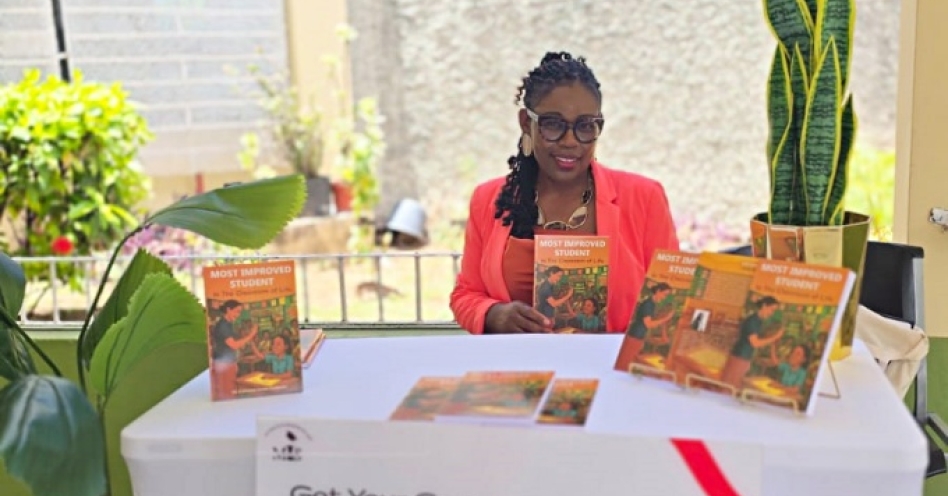
Dr Euphemia Burke Robinson
In order to help others to understand the mindset that mobilised her actions as well as assist current students who may feel forgotten or whom society may deem slow and therefore overlook in favour of others who fit the standard academic mould, Robinson decided to chronicle her story on paper. Last year she completed and published the book ‘Most Improved Student in the Classroom of Life’, which she states offers guidance and, more importantly, grace to those who may feel as if learning was not designed with them in mind.
Now as a motivational teacher and preacher, she shares her story with students who seek a safe space to be themselves regardless of their IQ, education level or academic performance.
“When I am invited to be a guest speaker, individuals would say to me, ‘Your story is inspiring; why not commit it to paper and immortalise the memories’, and so that’s what I did,” she said.
She started writing in 2022 with the intention to speak about intimate partner violence and her own experiences in her marriage. However, her editor suggested separating the subject matters and addressed first the topic of making a mental paradigm shift in educating oneself.
“The response so far has been overwhelmingly beautiful,” she said in an interview with Old Harbour News. “At first I ordered 50 books on Amazon, and they were all sold before I even got the package, and then I decided to print locally as it would work out better both logistically and economically, and it is going very well.”
“The book is a memoir of a time in my life when I struggled immensely,” she continued. “I learnt to spell my name when I was around 11 years old. When I was going to do my common entrance exams, my teacher shared that I would not pass but wanted me to get the experience. I got another chance to stay in grade six and re-do the exam, and this time I started to pick up. She later gave me a prize called ‘Most Improved Student’, and it was the first time I felt like ‘smaddy’ and it set off a hunger inside of me for wanting to experience that again, and so I evolved.
“I am not certain if I have a reading disability because I was never formally assessed. What I do know is that I hated school and feared reading in front of my classmates, so I’d hide away from class. Looking back, my home environment was also prohibitive in that there was no reading material. All that was in the home were a few pieces of furniture, so we didn’t have books or things that could stimulate reading. My older siblings also struggled with reading, so they didn’t get the chance to sit the common entrance, and my mother was not able to read. I do know that now if I am called to read, I still have the jitters, but I would have, over the years, practised enough so now I can order the butterflies in my stomach. So the difference now is that I developed the skill of reading and manage myself better.”
Originally from Garden Hill district in St. Catherine on the Juan de Bolas Mountain range, Euphemia’s early life was far from an easy one. “There was no transportation in the area, so we had to walk to the neighbouring community of Point Hill. My dad was a carpenter, and we lived in a small one-bedroom house which my father made with his own hands. Now I stretch my mind to wonder how seven of us held in that small space. Another thing that was phenomenal about the space was that everything was made by my father, including the beds, table and dresser, so we had all the basics except for a mirror because my father couldn’t make mirrors,” recounted Burke Robinson, a past student of Old Harbour High.
“We were very poor, but I have never gone to bed without my dinner, and I never went to school without my breakfast because where we were living there was lots of cultivation with all the fruits and vegetables you could think of. What we didn’t have was enough protein to go with it. Now my mom was a poultry farmer, so she would give us the chicken neck, liver, foot and gizzard, but we never got the actual chicken because the rest was for economic purposes. What we had were some ‘salt ting’, so the shad (fish), salt mackerel and saltfish was our food during the week. My mother was a real economist who could stretch a dollar 50 ways. My father, on the other hand, was very skilful, as he made all the houses in Garden Hill, but for some reason, all of his money went to the bar. He had a strange relationship with alcohol, and that relationship kept him away from money. My father was not a provider, my mother had to work harder because she did farming, caregiving and washing for neighbours, etc.”
Based on where her home was situated, it would not have been possible for her to get to Old Harbour High School as a daily commute. Hence, at the beginning of secondary education, she left home to live with her aunt in Bartons. Here, all the children in the home were considered brilliant, doing spelling bees and extra academic work, so Euphemia worked extra hard so that she was not left behind. “I got really inspired to excel,” she said. “My teachers were also exceptional as they allowed me to come to extra classes without having the money to pay. All they asked of me was to succeed in my exams. In that kind of enabling environment, we did so well that my batch was the pioneers for the sixth form programme that was established in 1996.”
With time, she naturally became a disciplined and methodical student. “I usually tell my friends that if they have to study for one hour to understand a topic, I know I have to study for four to learn the same concepts. From grade six, I
would study late at nights and tried extra hard to expose myself to different materials. At Old Harbour High at the time, they had a streaming system there and having landed in the class that was called the ‘cream of the crop’,
we were told that students in the other classes were working hard to get our positions, so when I learnt that, it meant I had to be studying exceptionally hard regardless of whatever chores I had. I had index cards all around the house even when doing chores because I didn’t want to lose my position.”
Having completed her secondary education, she then contemplated her next move. “My family was still struggling financially. My principal at Garden Hill Primary knew the situation, so he gave me a pre-trained teaching job for eight months. A vacancy later came up, and he gave me the job. Two years later, I went to the Mico College, where I did well because of my study habits and the forming of groups as I love studying in groups, so that I can challenge the knowledge and bounce ideas off of others,” Burke Robinson said. “In my first semester, I did a math exam, and I failed it. And so I befriended the guy in the class who got 100%. There is no way he was not going to be my friend. I left Mico with five awards and the top math student prize for my year. Once I learn something, I find someone to teach it to because doing that solidifies it in my mind and helps me manage my metacognition. Also from high school, I knew I could not manage a lot of things all at once, so I chose subjects that are co-related, hence I did home economics and biology because you learn about the digestive system as well as nutrition. I had to be strategic in my educational choices.”
Part of her mandate is to give back and be a mentor to students who are challenged academically and struggle with self-worth and self-esteem issues.
“I have no problem teaching slow students because of my own struggles. I remember one year my principal gave me a set of grade three students and I was able to work with them and take them to the next level, and my principal said, ‘You did such an amazing job that I’m going to have you move with them because I don’t want to lose their momentum’. It is not an easy road and success does not come overnight, but if you genuinely love what you do, you can make a change, and I genuinely enjoy working with students who need just a little more,” she said.