Turning silence into success | Old Harbour’s Kemoy Campbell directs deaf disability into university degrees in the US
Article By: Fern Fagan
-

- Jun 07, 2026 08:34 AM | News, Education
-
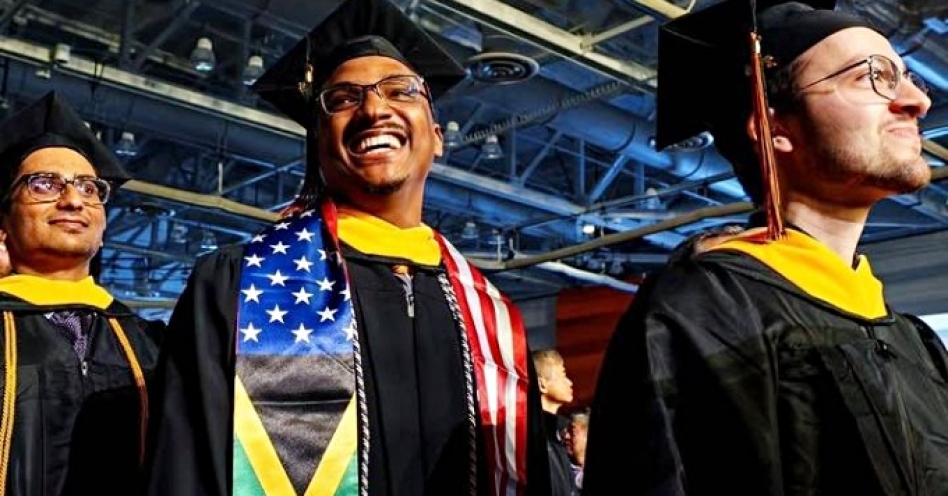
Kemoy Campbell (centre) pops a bright smile during the recent graduation ceremony at the Rochester Institute of Technology, New York.
For Kemoy Campbell, growing up deaf made life challenging to say the least, but it was a challenge that built not only his resilience, but his character, as he knew from early that he had to work almost twice as hard as others to achieve the same results.
With time, tenacity and talent, this Old Harbour native was able to turn a promise into purpose, culminating recently when he graduated from Rochester Institute of Technology in New York, with a Master of Science degree in Software Engineering. From very humble beginnings in Marlie Mount to the halls of academia, he beat the odds to earn a place as a young professor at a leading university in the ‘Big Apple’.
Speaking exclusively to Old Harbour News over a course of several days and numerous messaging via email, Campbell shared his awe-inspiring story that will certainly give hope to the most doubtful.
“My early life was a mix of ‘normal’ and adaptive,” he said. “Normal in the sense that I had a typical childhood, but I lost my hearing at the age of four, which meant I had to adapt early.
“My mom taught me how to lip-read, and I became very good at it. I was already speaking before I lost my hearing, so I continued speaking throughout my life.
“Looking back, my immediate family never treated me differently or told me I couldn’t do something. The community experience was mixed. People close to my family often included me in activities, and I grew up playing cricket, football in the street, and doing all the usual things kids do.”
While home life was stable and nurturing, navigating the education system, especially coming from a poor background, was like overcoming an obstacle course for Campbell.
Recounting those challenging times he said: “Before my mom learned about deaf schools, I attended a mainstream hearing school like any other child. However, I missed a lot of information because I couldn’t follow everything visually or audibly. Teachers would often speak while facing the board, and group conversations made it even harder to keep up.
“To compensate, I effectively did ‘double schooling’. After classes, my mom would repeat the lessons at home. She also ran informal ‘summer school’ sessions for both my hearing sister and me so we could catch up or stay ahead. Before learning sign language, my communication relied on speaking, reading, writing, and lip-reading. However, lip-reading was not always reliable, especially when words sounded similar, people had different speech patterns, or visual cues like moustaches made understanding harder.”
Kemoy also shared that despite new age political correctness, the correct terms for his condition are not ‘hearing impaired’ but actually ‘deaf’ or ‘hard of hearing’. Inevitably, been ‘different’ for him meant that other children were not always nice.
“Outside my family, some people mocked me when they realised I was deaf. My younger sister, who is only two years younger than me, often defended me, and at times even physically stood up for me when people were unkind,” he shared. “In the broader community, some people treated me differently. Communication was also challenging in group settings, especially when multiple people were speaking at once, which sometimes left me out of conversations. There were also individuals who underestimated me or assumed I wouldn’t accomplish much because I was deaf.”
As mainstream schooling made it difficult to follow lessons and participate, he started attending deaf school at age eight, which for obvious reason poses a new challenge “because I didn’t yet know sign language”.
“However, once I began learning it, school became much more enjoyable,” he added. “I love learning, and I’ve always considered myself a ‘nerd’ both in and out of the classroom.” Amid his new challenge assimilating in a school setting for children with similar disability, this nerd as he refers to himself, became a devout Christian – a whole another challenge for him.
While at Caribbean Christian Centre, he learned just how awesome Christ’s love was, and so he made a commitment to continue to bask in that love daily – reminding those struggling with any kind of disability to dream big and pursue it with vigour and purpose.
“Do not let circumstances or people define what you believe is possible. This is not to ignore real challenges like poverty or hardship. Those are real, but they should not stop you from pursuing your goals,” he stated.
“From my own experience, my family didn’t have much growing up. We didn’t even own a computer until I was 20. But that didn’t stop me from learning. I used books, school resources, and internet access at the library to study computers. When I was learning programming, I would visualise what the code would do in my mind since I didn’t always have access to a computer to test it. That mindset helped me keep going despite limitations.”
Despite the challenges, Campbell stayed motivated. As he emphasised, he grew up with a strong ‘can-do’ mindset.
“One of my early memories of reading comes from going through pictureless books at my grandfather’s bedside,” he said. “My mother has been one of my greatest influences. She consistently stressed education and demonstrated resilience through her work. She held many different jobs, including security guard, working with the NWC [National Water Commission] doing field and maintenance work, helping build houses, and more. She showed us that anything is possible with effort and determination.
“I was also motivated by books, including Think Big by Ben Carson, as well as inspirational and fictional stories from movies and literature.”
After completing high school Kemoy went on to complete HEART certification programmes before migrating to the United States at the age of 20 to do Computer Science in college.
“I’ve always loved computers and the idea of building things with them,” he tells Old Harbour News. “The possibilities feel limitless. I also enjoy tinkering and pushing systems beyond their limits, which naturally developed into an interest in cybersecurity. I have a Bachelor’s degree in Computer Science, and I’m planning to pursue a PhD in Cybersecurity, so a Master’s in Software Engineering makes sense as part of building a well-rounded background and a broader, deeper knowledge base.”
His success, he opined, cannot be credited to any single person, as it truly took a village.
“My family played a major role by believing in me and always encouraging me to aim high without limitations. My community also supported me and included me in activities. Teachers and principals throughout my education guided me along the way. My closest friends, who feel like family, have also been a constant source of support. My wife, who is also deaf and recently completed her PhD in Chemical Engineering, has been a major supporter of my dreams and a constant source of encouragement during my master’s program.”
Becoming a professor is a position that he never initially envisioned but is a role that he now has genuinely embraced.
“I never imagined I would become a university lecturer, but I genuinely love it. A major part of my role is helping students think bigger about their goals and futures. I enjoy seeing the moment when something ‘clicks’ and a concept suddenly makes sense. For me, teaching is not just about academics, but also about mentorship and helping students grow personally and professionally,” he said.
“In my role as a lecturer, I teach a wide range of courses, including website development, mobile application development, introductory programming, cybersecurity, Linux, and more. Because of this variety, the work is never boring or repetitive. Every course brings something different, which keeps it engaging. Beyond the university classroom, I also participate in STEM programs during the academic year and summer, teaching students from middle school through high school.”