70% water loss? The number that should have ended careers and started investigations | How NWC turned a system failure into a procurement engine
Article By: Roger McKenzie
-

- Oct 06, 2026 08:04 AM | Commentary
-
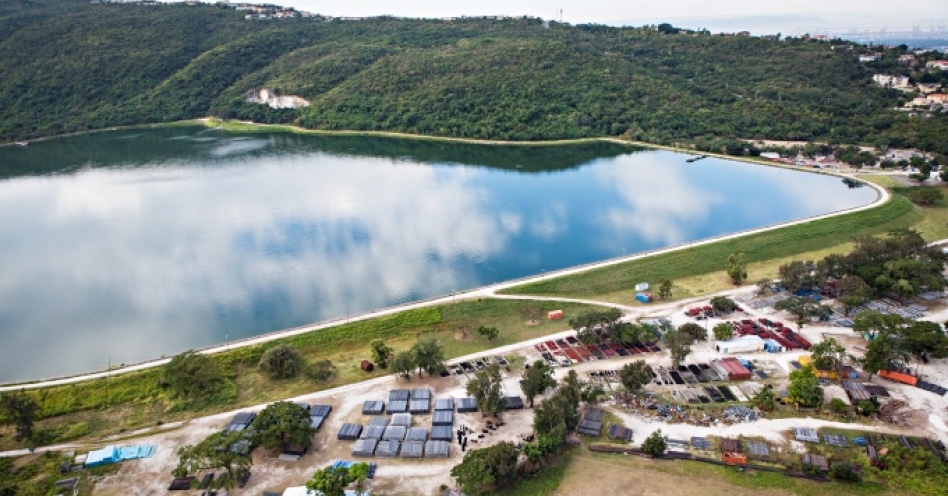
NWC Mona Reservoir
She offered this as a reason desalination is not economically viable and cited loss reduction as the priority intervention. The number was reported. It was not questioned. It should have stopped the webinar cold.
The Math That Does Not Add Up
The 70% figure is a national average, heavily distorted by legacy rural networks where losses reach 74% to 80%. In the Kingston and St. Andrew Corporate Area, the NWC's own co-management programme with Miya reduced NRW to between 35% and 40%. The webinar was discussing a KSA supply crisis using a national figure that does not reflect KSA reality.
Even at the corrected 40% loss rate, the math is damning. To deliver 45 to 50 MGD of usable water after a 40% loss, the NWC needs to push 75 to 85 MGD through the network. Total maximum treatment throughput from all KSA sources combined tops out at 55 to 65 MGD. The system cannot physically meet normal demand before a drought even begins. It is structurally short every single day.
Now apply the national 70% figure as Campbell-Francis implied. Delivering 45 to 50 MGD after a 70% loss requires 150 to 167 MGD of treated input. The entire installed infrastructure feeding Kingston and St. Andrew cannot produce one third of that. The Hope, Wag Water, and Yallahs rivers combined cannot yield 150 MGD. It is physically, hydrologically, and infrastructurally impossible. If the 70% figure were real and applied to KSA, every tap in the Corporate Area would have been permanently dry for the better part of a decade. The fact that taps run at all disproves it.
The NWC cited both physical leakage and theft as the combined sources of the 70% figure. That admission is more damning than either component alone. Physical leakage at that scale requires a network in catastrophic disrepair. Theft at that scale means the NWC has lost control of its distribution network entirely. If both are simultaneously true, the NWC is presiding over a system collapsing from both ends at once. In neither case does the figure justify delaying rainfall-independent production. In every case it demands immediate independent investigation and the full accountability of every executive who cited it publicly without being required to prove it.
A National Security Crisis Nobody Is Publishing
As of 30 September 2026, Hermitage Dam stands at 40.3% and Mona Reservoir at 33.5%. At the same point in 2024, Mona was at 98.4% and Hermitage at 100%. In 2025, Hermitage was at 100% and Mona at 56%. Today both sit at critical drought thresholds with below-normal rainfall projected through December 2026, compounded by a super El Niño disrupting Jamaica's bimodal rainfall cycle for six consecutive months.
The arithmetic is stark. Mona at 33.5% holds approximately 270 million gallons. Hermitage at 40.3% holds approximately 158 million gallons. Combined: approximately 428 million gallons. At 55 to 65 MGD treatment throughput with zero replenishment, that is 6.5 to 7.8 days of maximum output before both reservoirs are exhausted. Even crediting drought-stressed wells and river intakes at 20 to 25 MGD supplementary input, the reservoirs reach critical minimum operating levels within four to six weeks. Below that threshold, treatment plant intake pipes cannot draw effectively regardless of what rivers and aquifers contribute.
The 2019 experience of five weeks without supply was not an anomaly. It was the mathematical endpoint of a rationing cycle applied to a storage system at critical levels. Current storage is lower than the 2019 entry point. Rainfall projections are worse. The same rationing game runs out faster. When it does, communities on day-on day-off schedules move to days without supply. Communities already under restriction move to trucked water only.
This is a national security crisis. Water is not a utility amenity. Managing it with storage tanks and rationing schedules while officials discuss 2028 procurement timelines is not crisis management. It is the administration of a predictable collapse. Describing it as a national security crisis is not alarmism. When Mona sits at 33.5% and Hermitage at 40.3% while 107 NWC supply systems face drought conditions and the Met Service projects below-normal rainfall probability of 50% to greater than 70% through December, treating public water distribution as routine utility management is an admission of paralysis dressed as procedure.
Planned to Fail, Planned to Profit
The Rio Cobre Water Treatment Plant was first presented to Cabinet in 2009. Cabinet approval came in March 2016. A Water Purchase Agreement was signed in November 2022. Ground was broken in March 2024. It is currently 53% to 60% complete with a May 2027 target. A project conceived in 2009 will, if it meets its latest deadline, take eighteen years to deliver.
Critically, Rio Cobre feeds Spanish Town, Portmore, and sections of western Kingston through a separate distribution network. It does not replenish Mona or Hermitage. Communities in central and eastern Kingston and St. Andrew facing the worst lock-offs today will see no direct relief from Rio Cobre when it completes. Claiming it solves the KSA reservoir crisis is geographic misdirection.
The 70% figure is the engine keeping this cycle running. If false, it provides permanent justification for pipe replacement programmes, meter contracts, and loss-reduction studies that never produce verified results because the baseline was never independently verified. If true, it represents the most catastrophic infrastructure failure of any Caribbean utility in history, demanding emergency declaration and full accountability. Instead it was stated at a webinar as a planning parameter and the conversation moved on.
What Was Already on the Table
Campbell-Francis cited electricity cost as making desalination economically unsound. She did not mention that the NWC's own 2020 Expression of Interest for a desalination plant explicitly included renewable energy systems as part of the scope. The NWC issued a procurement exercise acknowledging the energy barrier, attracted no viable outcome, and is now citing that same barrier as the reason desalination cannot work.
In May 2019, Kingston Venture Capital submitted a detailed unsolicited proposal: a 35 MW hybrid renewable power plant sized to power a 15 MGD desalination facility, with surplus generation sold to JPS under a secured contract, structured as a lease requiring zero upfront capital from the NWC. It was built on a non-binding 2018 MOU. When KVC requested a binding instrument to protect its IP, it was never provided.
On 26 June 2019, with communities still under active lock-offs, the NWC recommended discontinuing discussions. Approximately one year later the NWC issued a public EOI covering substantially identical ground at the same location without acknowledging a private party had already mapped it. That EOI produced no plant. Seven years later the NWC has no desalination capacity, and the same reservoir numbers are back on the screen. The
Question Nobody Is Asking
Nobody has answered what happens if rainfall does not return by January 2027. Nobody has published the days of effective supply remaining. Nobody has commissioned an independent audit of the 70% figure broken down by zone or measurement methodology. Nobody has treated this as what it is: a national security crisis.
Mona is at 33.5%. Hermitage is at 40.3%. Nine of fourteen parishes are in drought. The structural solution is three to four years away. The 70% figure that should have triggered a national infrastructure emergency or a fraud investigation is being discussed at webinars as a planning parameter. Either careers should end and investigations should start, or the public should be told plainly that the number is not real, who benefits from its circulation, and what the water system actually looks like without the fiction that 70% of it is disappearing before it reaches the people who paid for it.
The Integrity Commission, the Office of the Contractor General, and the relevant parliamentary oversight committee have the mandate and the documented record to demand answers. The reservoir levels will not wait for them to find the courage to ask.
Roger McKenzie is the founder and CEO of Kingston Venture Capital. Send feedback ti editorial@oldharbournews.com