The schools we celebrate and the schools we overlook: What school rankings don’t tell us
Article By: Dr Leo Gilling
-

- Jun 08, 2026 11:02 AM | Commentary
-
Yet there are other questions that many in Jamaican society would rather avoid. They sit quietly in the background of our education system — rarely discussed openly, yet influencing almost every conversation about school success.
After examining secondary school ranking reports based on CSEC and CAPE performance over roughly the past two decades, I have begun to wonder whether we have been asking the wrong question. Perhaps the most important schools in Jamaica are not the schools at the very top of the rankings. Perhaps the most important schools are the ones in the middle. For nearly twenty years, many of Jamaica’s highest-performing secondary schools have remained remarkably consistent.
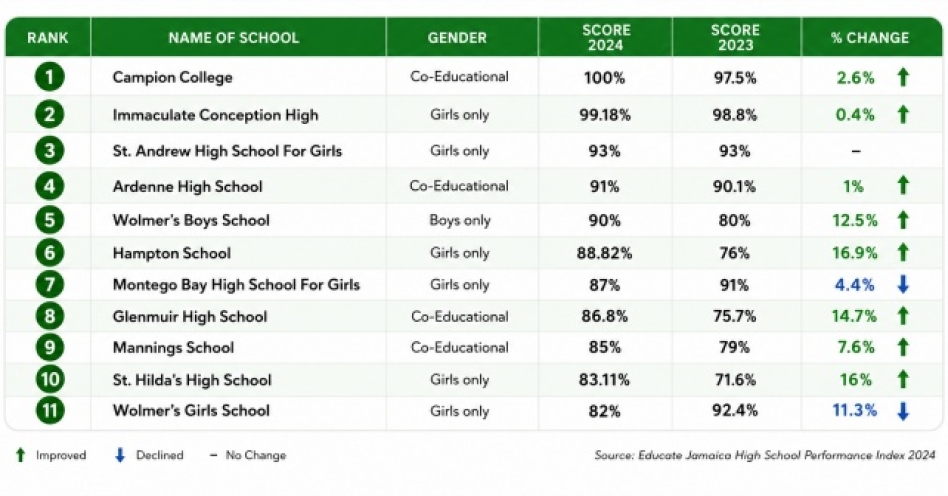
The names are familiar. Campion. Immaculate. St. Andrew High. Wolmer’s. Ardenne. Glenmuir. Hampton. There have been movements up and down, but the overall composition of the elite tier has remained relatively stable.
At the opposite end, many schools facing persistent challenges have also remained relatively stable in their position within the system. Neither reality is particularly surprising.
Schools that consistently receive some of the strongest students in the country often continue to perform well. Likewise, schools serving communities facing significant social and economic challenges often continue to confront those realities. Yet Jamaica has approximately 180 secondary schools. The schools that dominate public discussion each year represent only a small fraction of the education system. Most schools exist somewhere between the very top and the very bottom of the rankings. And it is in that middle space where the most interesting story may be unfolding. While the schools at the top and bottom often attract the greatest attention, many schools in the middle appear to experience the greatest potential for change over time. Leadership changes. School cultures evolve. New programs are introduced. Performance improves, stagnates, or declines.
In other words, the middle of the system may be where much of Jamaica’s educational transformation is actually occurring. Transformation is often hidden in places where rankings are not looking. Part of the challenge is that Jamaica has multiple ways of defining school performance, and they do not always tell the same story.
When annual league tables are published, performance is typically understood through examination outcomes — CSEC passes, CAPE results, distinctions, subject passes, and overall academic achievement. Those measures matter. But they are not the only measures that matter. Jamaica also evaluates schools through broader frameworks that examine leadership, teaching quality, student support, school climate, governance, curriculum delivery, improvement planning, and overall institutional effectiveness.
As a result, a school can be highly ranked academically while performing less impressively in broader measures of school effectiveness. Conversely, a school sitting somewhere in the middle of the rankings may be demonstrating exceptional leadership, a strong school culture, effective teaching practices, and sustained improvement over time. Those are not the same things. In fact, we often confuse three related but distinct concepts: academic outcomes, school effectiveness, and educational transformation. Academic outcomes ask a simple question: What results did students achieve? School effectiveness asks a different question: How well is the school functioning? Educational transformation asks something deeper still: How much progress did students make because of the school?
These concepts overlap, but they are not identical.
A school may rank near the top of the examination tables because it receives students who already arrive highly prepared. Another school may rank much lower while helping students make extraordinary gains relative to where they started. Both accomplishments deserve attention. Yet one receives far more public recognition than the other.
The schools that make headlines are usually the schools with the highest examination outcomes. The schools that rarely make headlines are often the schools demonstrating the greatest improvement. We celebrate results. We pay far less attention to effectiveness. We pay even less attention to transformation. Yet transformation may be the most important measure of all. A school that improves literacy, strengthens its culture, develops stronger teaching practices, increases attendance, reduces behavioural challenges, and helps students outperform expectations may be achieving something remarkable — even if it never appears near the top of a ranking table.
This is why many education systems have increasingly explored value-added approaches to measuring school performance. The question becomes not simply, “How did students score at the end?” But rather: “How much did students improve because of the school?”
That distinction matters because education is not a race with identical starting lines.
A school receiving students who arrive with strong literacy skills, extensive parental support, high confidence, and strong academic preparation begins from a very different position than a school receiving students who arrive carrying academic gaps, social challenges, learning difficulties, trauma, or instability.
This is not an excuse. It is simply a reality.
The question therefore becomes: What exactly are we measuring when we rank schools?
Are we measuring outcomes? Or are we measuring transformation?
The Jamaica Education Transformation Commission recognized this challenge when it explored value-added approaches to school effectiveness. The commission acknowledged that raw outcomes alone do not necessarily tell us how much a school contributed to a student’s growth. A school may produce exceptional examination results because it received exceptionally prepared students. Another school may produce more modest examination results while helping students make extraordinary gains. Both stories matter. Yet only one usually receives public attention. This raises an intriguing possibility. What if the schools we should be studying most carefully are the schools that move? What explains a school that climbs twenty places over a decade? What explains a school that steadily improves despite difficult circumstances? What explains a school that suddenly declines?
The answers to those questions may tell us far more about educational improvement than simply examining the schools that have occupied the top positions for decades.
The top of the table tells us who is successful. The movement within the table may tell us how success is created. Perhaps the most important question is not which school finished first. Perhaps it is this: If two schools begin from very different starting points, should we expect success to look exactly the same?
Dr. Leo Gilling is a criminologist, educator, and diaspora policy advocate. He writes The Gilling Papers, where he examines policing, public safety, governance, and community-based solutions in Jamaica and across the African diaspora. Send feedback to editorial@oldharbournews.com